India has been trying to reduce its dependency on oil for the past
few decades, and the latest step in doing so is the introduction of
E85 fuel. Public Sector Oil Marketing Companies (OMCs) achieved the
target of 10% ethanol blending in petrol in June 2022—five months
ahead of schedule during the Ethanol Supply Year (ESY) 2021-22.
Blending was further increased to 12.06% in ESY 2022-23, 14.60% in
ESY 2023-24, and reached 20% in 2025. India achieved this 20%
blending feat nearly five years ahead of its original 2030
target.
The ethanol used for blending is primarily derived
from crops like sugarcane, which helps support Indian agriculture.
Just a year after launching the 20% blend, Union Petroleum and
Natural Gas Minister Hardeep Singh Puri launched 'E85 fuel' on June
5, 2026.
What is E85 fuel, and can any vehicle use it?
E85
is a high-ethanol fuel made of 80–85% ethanol and 15–20% petrol.
It is specifically designed for Flex-Fuel Vehicles (FFVs). These
vehicles are built to run efficiently on petrol mixed with any level
of ethanol, ranging from 20% to 100%, without sustaining engine
damage. Because ethanol is corrosive, FFVs are equipped with
specialized ethanol content sensors, as well as ethanol-resistant
fuel lines and seals.
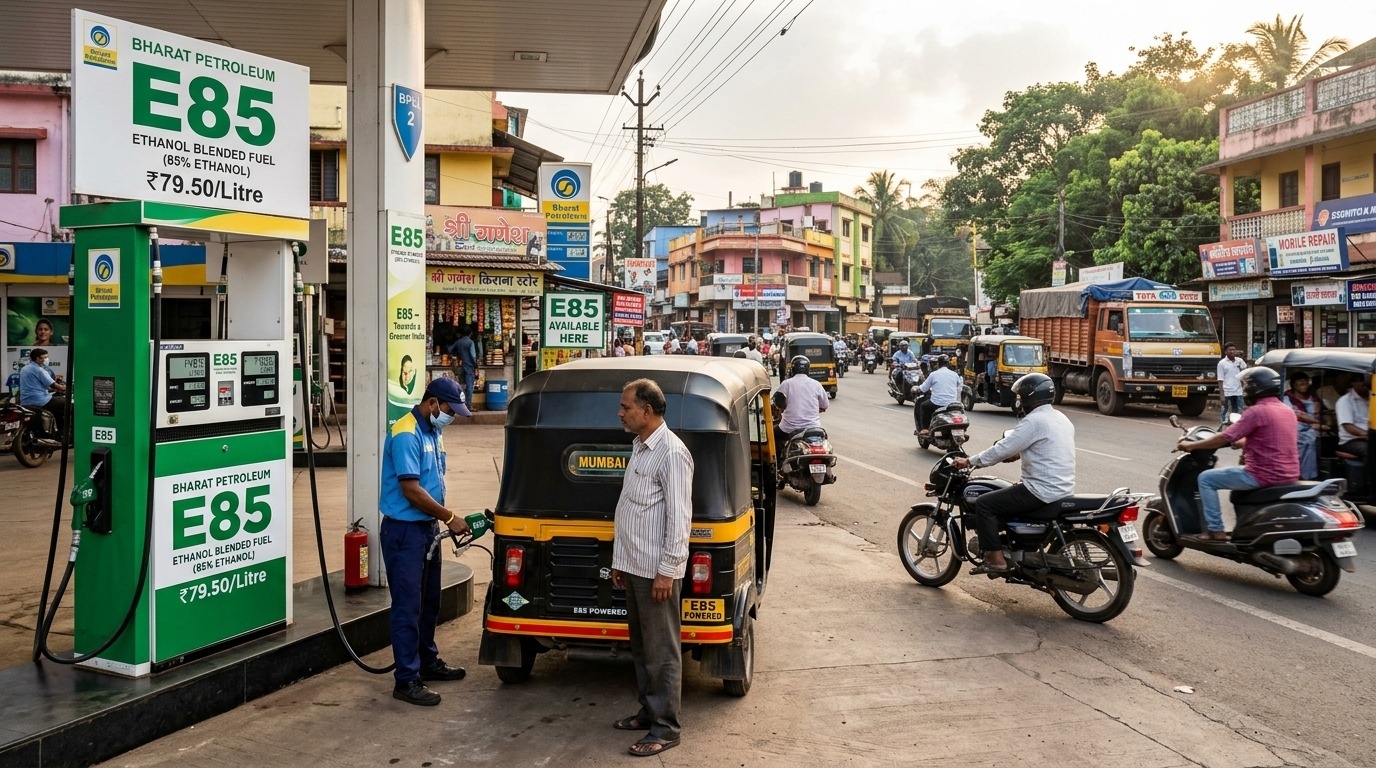
E85 fuel is priced at ₹82.12 per
liter, making it significantly cheaper than regular petrol, which
costs around ₹103 per liter in Delhi. However, the vast majority of
petrol cars currently sold in India cannot use E85. The high ethanol
concentration requires these specially designed engines; running E85
in a conventional car can cause performance issues and long-term
mechanical damage.
The Road Ahead:
The good news is that
the automobile industry is already launching new car and bike models
with flex-fuel engines. The E85 rollout has started across 48 retail
outlets run by public sector OMCs. This will expand to 500 outlets by
December 2026 and about 5,000 by December 2027, helping raise India’s
overall ethanol blending level to nearly 26% by 2030-31.
Union
Minister Puri clarified, "Your E20 vehicle will run for a long
time, E20 and E85 are fuels from two different categories, designed
for different types of vehicles. The arrival of E85 by no means
implies that E20 or petrol vehicles will be discontinued." He
added that raising the blending rate from 1.53% in 2014 to 20% today
has saved the government over ₹1.84 lakh crore in foreign exchange
and substituted nearly 302 lakh metric tonnes of crude oil
imports.
The journey toward E85 adoption is just beginning.
While the fuel is now available, flex-fuel vehicles remain rare, and
the fuel itself is limited to 48 urban outlets across Delhi-NCR,
Pune, Mumbai, and Nagpur. Only time will tell how much E85 will drive
India's economic and technological growth.