
Remember the days when social distancing was compulsory? Everyone wore N-95 masks, "work from home" was a daily routine, and students attended classes online. It was the Covid virus that had brought the world to a halt. Many people migrated back to their native places, and "quarantine" was mandatory for anyone crossing international borders. Goa, too, was paralyzed to a certain extent.
Today, we have moved on from those Covid days. However, three researchers have just published Goa’s first end-to-end Covid-19 genetic epidemiology assessment. Covering five pandemic waves over 54 months, it is the first published study to provide a comprehensive, state-level genomic review of Goa’s SARS-CoV-2 history. This study was published on Zenodo on June 11.
The report states that 110 distinct genetic forms of the coronavirus were reported in Goa. The researchers validated and published the complete genomic trail of every coronavirus variant recorded in the state from December 2020 to June 2025.
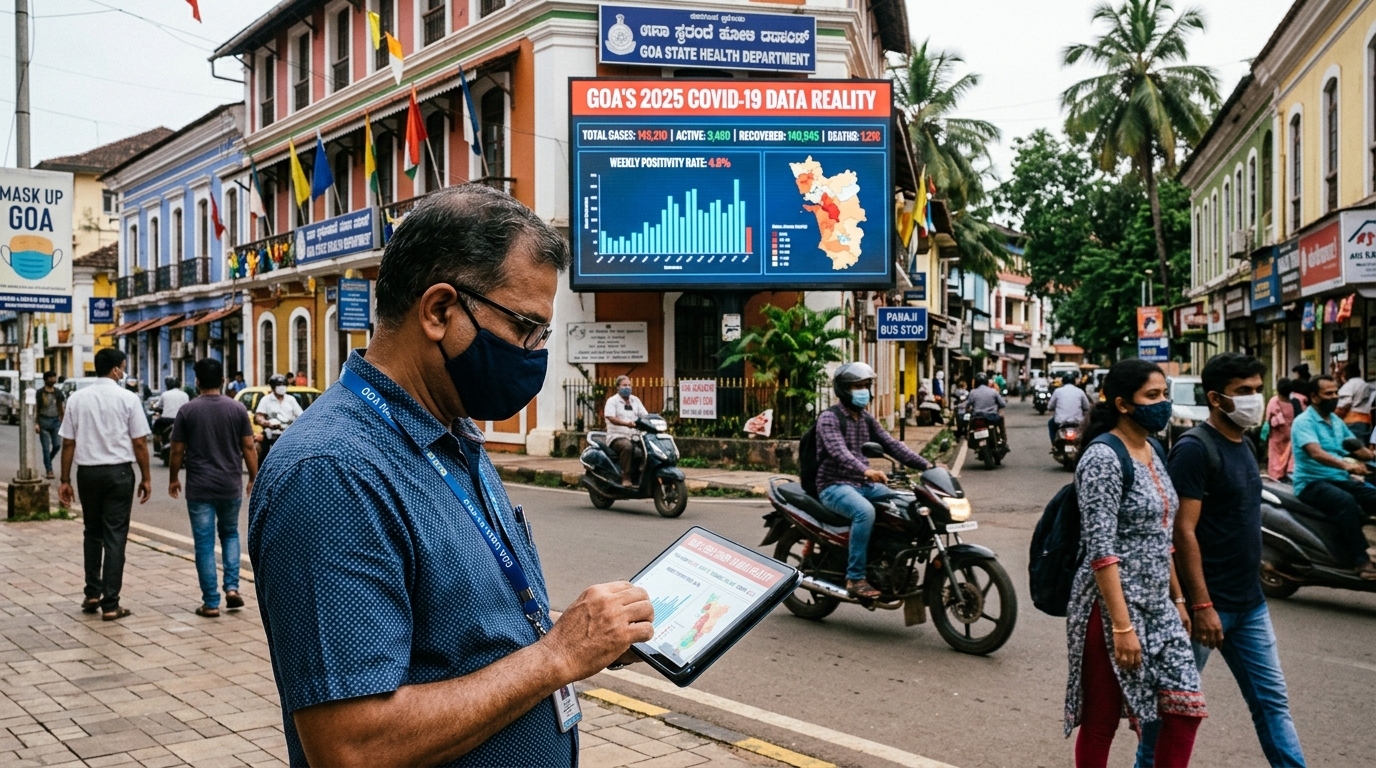
Retired scientist Nandakumar Kamat, Marina Albuquerque from Government College Khandola, and Samantha Isabela Pinto, an independent researcher from Moira-Bardez, conducted the entire research. According to Nandakumar Kamat, the analysis also exposed drawbacks in Goa’s Covid-19 data system. Kamat claimed that while the virus was still being detected in Goa in 2025, the government maintained no functional public genomic surveillance dashboard that year; even though confirmed positive samples were being sequenced and uploaded to global databases.
The research shows that seven sequences were confirmed between May and June 2025, all within the North Goa district, indicating active viral circulation. More importantly, newly evolved recombinant variants, XFC and XFG, were also recorded.
Kamat questioned why a public dashboard was not activated, given that the virus was known to be circulating in 2025. He further noted that the WHO's International Health Regulations and India's National Health Policy both require the timely public disclosure of communicable disease data.
The study highlighted that Goa's genome sequencing rate fell far below the WHO benchmark. "The WHO advises sequencing at least 5% of confirmed positive samples continuously," Kamat added. "Ignoring that, Goa's overall sequencing rate during the pandemic was only around 0.5%."
According to Kamat, a previously unreported double-variant event was discovered in Mapusa during the study. In April 2021, two different variants 'Delta' and 'Kappa' were found circulating simultaneously in the commercial hub. This occurred weeks before the deadliest wave peak in May 2021, a finding Kamat claims has never been documented before.
Kamat also stated that Goa, as a major international tourist destination, presented a unique epidemiological environment for SARS-CoV-2 genomic monitoring, leading to the detection of 110 unique genetic forms across five waves. This high diversity was likely driven by Goa's intense international connectivity through tourism.
Furthermore, Kamat notes that the 2021 Delta wave was incredibly intense, with more than half of the 1,274 analyzed sequences belonging to the Delta variant or its sub-types. This scientifically confirms what Goa experienced firsthand during the severe oxygen shortages of that year.
The research identified multiple anomalies, including a complete reporting gap for the year 2024. During this period, Goa’s sequences is missing from the global genomic database. Kamat pointed out that not a single sequence with 2024 collection exists in international records.
Kamat expressed deep concern over the government's handling of the situation, noting that a complete lack of genomic data for an entire calendar year indicates that India's national genomic surveillance policy was not fully rolled out in Goa.
Finally, he emphasized that the study calls on to the Government of Goa to formally request the Union Ministry of Health to extend the existing port health surveillance framework to both of Goa's airports. This would cover SARS-CoV-2 and any future respiratory pathogens of concern; a step Kamat notes is entirely within the state's authority to initiate under the Epidemic Diseases Act.
Goa's 2025 Covid-19 data reality
Remember the days when social distancing was compulsory? Everyone wore N-95 masks, "work from home" was a daily routine, and stude
Latest in HEALTH
 NEW
NEW
HEALTH
SGDH to Get MRI Facility in July, Full Upgrade by October: Vishwajit
Health Minister Vishwajit Rane announced that MRI services will be launched at the South Goa District Hospital in July

HEALTH
FDA to Train Street Food Vendors in Hygiene and Food Safety
Food and Drugs Administration (FDA) has decided to provide hygiene and food safety training to street food vendors across Goa